About Christmas TV History

Saturday, February 1, 2014

Arthur Rankin, Jr. (1924-2014)


Rudolph and Clarisse from the 1964 TV special

It is with sadness that I share the news that Arthur Rankin, Jr. passed away on January 30th.  Rankin was known as half of the creative team of Rankin/Bass, the two men who produced and directed some of the best known, most-beloved Christmas entertainment ever made. 

You may not immediately recognize the names of Arthur Rankin, Jr. and Jules Bass but their work stands for itself.  The first animated Rankin/Bass TV special was 1964's Rudolph the Red-Nosed Reindeer--the highest rated and most popular Christmas TV special ever made.  Despite this TV special turning 50 years old this upcoming December, it has never been forgotten or overlooked.  Rudolph has aired every year on a major network since its original release in 1964--a feat that's unmatched. 

Do you still watch Frosty each year? 

The animation of Rankin/Bass is most closely associated with stop-motion animation, a process they referred to as Animagic. However, they also made traditional cel animation, the style of animation used to create 1969's Frosty the SnowmanFrosty is the second most recognizable Rankin/Bass Christmas TV special and one that still airs each yuletide season on a major network on TV.


In addition to Rudolph and Frosty, I grew up watching the 1970 TV special Santa Claus is Comin' to Town.

It's impossible for me to imagine a Christmas without watching at least one of the Rankin/Bass TV specials.  What a wonderful legacy Arthur Rankin, Jr. leaves behind, one that brings so much happiness to millions of people and continues to be an important part of many viewers' Christmas traditions.  


The Heat Miser and Snow Miser from Rankin/Bass' 1974 TV special, The Year Without a Santa Claus.

Which of the Christmas/New Year's Rankin/Bass animated stories is your favorite?  Have you seen all twenty?  Can you name each one?  Click HERE to see my list.

To learn more about Arthur Rankin, Jr. and Jules Bass' legacy, you can check out the website of Rick Goldschmidt, the Rankin/Bass historian.

Monday, January 27, 2014

Partridge Family Christmas (1971)

Did you know that the title of this 1971 Christmas episode is a reference to the 1958 hit song "Don't Bring Your Guns to Town," sung by country music icon, Johnny Cash?
 
Although I blogged about this Christmas episode before, it was four long years ago.  I thought I'd update the essay and add some photos.  This classic episode deserves more attention anyway--did you grow up watching The Partridge Family on television, like I did?  Do you remember the second season episode "Don't Bring Your Guns to Town, Santa?"


The children are devastated when they realize they may have to spend Christmas stranded in the desert.

In this holiday episode, the family's tour bus breaks down on Christmas Eve in the desert on the way home after a performance in Las Vegas.  The Partridges take shelter in a nearby ghost town where an elderly prospector named Charlie entertains the children with a Christmas story about this once well-populated town, 100 years ago.

Luckily, they aren't alone.  A friendly resident of the town offers the family shelter until they can get the bus fixed.


After hearing Chris remark that he's worried that Santa Claus won't be able to find them in the desert, Charlie begins to share a story to address Chris' fears.

This western fantasy features the cast in the roles of the story told by Charlie, with Reuben playing Mean Sydney, the villain in a black hat who steals the town’s silver Christmas bell, Laurie as the schoolmarm, Shirley as the saloon girl, Danny as Little the Kid--a wannabe hero, and Keith as Sheriff Swell, who carries a guitar instead of a gun.


Keith (David Cassidy) plays the role of Sherrif Swell.  He wanders around the town, singing to its residents--much to their chagrin.

Laurie (Susan Dey) plays the role of the town's schoolmarm.

Mother Shirley (Shirley Jones in center) plays Belle, the town's saloon owner--she sells only lemonade and lollipops!  And, Chris (Brian Forster) and Tracy (Suzanne Crough) play young townsfolk.


The story's villain is Mean Sydney who is so rotten, he steals the town's bell.  This role is made even funnier when it's played by the push-over Reuben Kincaid (Dave Madden), the band's manager.

As Charlie tells it, this town was once afraid that Santa Claus wouldn't be able to find its residents in the desert.  They purchased a shiny silver bell and rang it every midnight on Christmas Eve.  Until one year, the dastardly Mean Sydney stole the bell.  After several attempts by Belle, the schoolmarm, and the Sheriff fail to convince Mean Sydney to give back the bell--a hero arrives in town to save the day.  Little the Kid offers to play cards with Mean Sydney in order to win back the town's silver bell and hopefully save Christmas.

You guessed it!  Danny (Danny Bonaduce) plays the hero Little the Kid.

Little the Kid challenges Mean Sydney to a poker game for the town's silver bell.
 The silly story ends with Little the Kid unable to win back the bell by midnight Christmas Eve.  However, when the townsfolk walk into the city's center, they discover that Santa Claus (and Christmas) had arrived despite their fears.  Someone suggests that it may not have been the bell that brought Santa to the town each year after all but perhaps the residents' holiday spirit.  And, Mean Sydney learns a lesson about giving.

Santa Claus didn't forget about the town even though they didn't ring the bell.

Any summary can't capture the silliness and word-play in the dialogue that makes this episode so special.  I'm not the only one who thinks this episode is out of the ordinary.  According to Joey Green's book The Partridge Family Album, Shirley Jones, David Cassidy, Brian Forester, and Dave Madden all name this Christmas episode as their favorite one.  (Most of them explaining that it was fun to do a fantasy episode outside of their regular characters). 

Mean Sydney taking on Little the Kid.

This episode also includes the song "Winter Wonderland" by the Partridge Family performing in Las Vegas.

I have to admit, I still love the music from this series.  Every episode in the series includes music--this one opens with the Christmas classic "Winter Wonderland" and ends with "Have Yourself a Merry Little Christmas."  Making these songs even more special--they both appear on the 1971 album The Partridge Family Christmas Card.


I own this album on CD and on vinyl--but sadly, I've lost the original pull-out Christmas card.

Interestingly, this episode also includes another song--one Keith as Sheriff Swell repeatedly sings throughout the episode.  Although it is not usually considered a Christmas song, this classic western tune adds more flavor to the western fantasy storyline. Used as a humorous running gag, Keith annoys everyone around him by singing his dialogue to the tune of the theme from the Western movie High Noon, the 1952 Oscar-winning song “Don’t Forsake Me, Oh My Darling.”


Actor Dean Jagger as Charlie.

Do you recognize the actor who plays Charlie the storytelling prospector?  He’s actor Dean Jagger who also plays General Waverly in the 1954 movie White Christmas.  How’s that for holiday provenance?

The entire family sings the holiday greeting "Merry Christmas" to the tune of "Don't Forsake Me, Oh My Darling" one last time, as they break the fourth wall, addressing TV viewers at home.

In the story’s end, the Partridges break the fourth wall to wish the audience a Merry Christmas.  What's your favorite TV sitcom or drama that includes holiday music?  Is your favorite mentioned in my latest book Merry Musical Christmas Vol. 1: The Best Christmas Music in TV Sitcoms and Dramas?


Thursday, January 23, 2014

Gilligan's Island Christmas (1964)


The first season of this sitcom was shot in stunning black and white.

With the hundreds of hours of new holiday programming generated each November and December, it's so easy to forget about the classics.  Sometimes we can lose track of our Christmas spirit unless we actively incorporate the past into the present.  How long has it been since you've seen the Gilligan's Island holiday episode?  With the title "Birds Gotta Fly, Fish Gotta Talk," it's easy to lose track of this first season Christmas installment.  But this classic episode is still seen each holiday season as the 1960s TV comedy continues to entertain into the 21st century (the series is currently airing on Me-TV).


On the island, the castaways' tree isn't a fir tree but rather, a bamboo one.

In this episode, the castaways are celebrating Christmas on the island by decorating a tree and discussing their fantasy Christmas wish lists.  Their hearts warm when Gilligan expresses that his wish is for the group's rescue off the island.


The seven castaways head to the beach to await the rescue boats.  As they are waiting, they reminisce about their first days stranded on the island.

It is then that the castaways hear a news broadcast from the radio that explains that a rescue ship is headed for an uncharted island after survivors from the SS Minnow have been spotted by a Navy weather device.  Gilligan's Christmas wish is going to come true and the castaways begin to pack and prepare for their eventual rescue.  The bulk of the episode's story are flashback scenes to the castaways' first days on the deserted island.

On their first moments on the island, the survivors discover that the damage to the SS Minnow will not allow them to head back out to sea.

In an attempt to keep Gilligan out of trouble, the Skipper sends his Good Buddy away from the valuable radio and transmitter--to catch fish on the beach.

The flashback scenes contain a story within-a-story of Gilligan complicating matters after the castaways wash up on shore after the SS Minnow was caught in a storm.  (Consult the series' theme song lyrics for the complete story of how the castaways found themselves on the island).  The flashback footage shows Gilligan being Gilligan--he falls through the holes in the damaged boat which reveal how un-seaworthy their boat has become.  The Professor and the Skipper decide to work with the radio devices to see if they can contact a passing ship to organize rescue efforts.  To keep Gilligan from causing more trouble, they send him to the edge of the water to try to catch fish for dinner.  But Gilligan's fishing rod casting snags the radio and the transmitter--hauling both electronic devices into the ocean! 


Is that marching band music?

Eventually, Gilligan catches a great many fish and piles them on the beach.  He's caught off guard when he can hear the voice of an exercise class instructor coming from the pile of fish.  It turns out that one of the fish has swallowed the radio--and perhaps one of these other fish has swallowed the transmitter?  Each of the castways begins talking into the fish carcasses to see if they can locate the transmitter as well. 

Ginger speaks into a fish to see if the transmitter is inside.  I guess this is where the meaning of the episode's title comes in, "...Fish Gotta Talk."

As the gang reminisces about their first days on the uncharted desert isle, they hear the latest news update on the radio.  The castaways spotted earlier have indeed been rescued!  However, they are not survivors of the SS Minnow as anticipated but rather ANOTHER group of castaways who have been stranded for eleven years on another uncharted island!  Our gang is disappointed that they won't be home for Christmas this year.

Santa Claus shows up on the beach of their uncharted desert isle.

Does Santa look a little familiar?  Hey WAIT A MINUTE--where's the Skipper?

In the final moments of the episode, as the survivors are sitting around their campfire on Christmas Eve, the group is approached by Santa Claus!  Though the group is feeling down about not being rescued (yet again), Santa reminds them to feel grateful for what they do have.  He explains that they are lucky to not still be lost at sea, on an island with food and water supplies, and he reminds them about their friendships.  As the castaways' mood shifts, Santa disappears, and the Skipper enters the campsite carrying fire wood.  Now the survivors are left to wonder about the true identity of their midnight visitor.

What did I miss? says the Skipper. 

While flashback episodes are often seen by TV viewers as lesser storylines--created by recycling clips from previously seen episodes--these clip shows are often used as Christmas storylines.  I believe that if a series is going to create a clip show, why not make it a holiday episode?  Isn't this the one time of year that we all indulge ourselves in our memories of the past?  Certainly TV characters might engage in the same nostalgia.  Yet, some clip shows are better than others.  Remember the 1956 Christmas episode of I Love Lucy?  In that meaningful clip show, we are reminded of several of the series' past highlights including the episode in which Lucy tells Ricky that she's pregnant, the episode of Little Ricky’s birth, and a clip of Lucy singing off-key during a barbershop quartet performance.  However, an example of a Christmas episode that clearly suffers from the recycling of clips is 1978's "Retrospective," (often airing as Parts 1 and 2 in syndication) from the series Diff'rent Strokes.  The hour-long holiday clip show is only the eighth episode in the first season, thus the recap covers all seven of the previous episodes!?  It often seems like a viewer's waste of time to reminisce about such a short period of time.  How do you feel about clip shows?


Another cool detail:  castaway Thurston Howell III (center of photo) played by Jim Backus is also known as the voice of Magoo in the Christmas animated classic Mr. Magoo's Christmas Carol.

It should be noted that the Gilligan's Island Christmas clip show is a little different.  The flashback scenes that construct this clip show are recycled from an unaired pilot (seen only by network execs) that was shot during the Fall of 1963 in Hawaii.  According to series creator Sherwood Schwartz in his book Inside Gilligan's Island, the execs wanted the first episode of the series to begin with the castaways looking for a way off the island.  (Since viewers know that the castaways are already stranded--courtesy of the opening theme tune lyrics--execs claimed an explanatory episode was not required).  Using the previously shot footage from the pilot in this Christmas episode, TV viewers finally get a look at what happened in the first moments when the the seven survivors first find themselves stranded on the island.  How cool is that?


Tuesday, December 24, 2013

Franz Kafka's It's A Wonderful Life (1995) and Peter Capaldi

The most exciting news this holiday for TV nerds like myself is the 2013 Doctor Who Christmas special, "The Time of the Doctor."  In this new episode, TV viewers will say goodbye to actor Matt Smith as the Time Lord re-generates into his newest incarnation with Peter Capaldi taking over as the new Doctor.  I've been a big fan of Capaldi's for a long time--he appeared in Prime Suspect (one of my favorite shows, a British-made police drama starring Helen Mirren).  But honestly, the first thing I think of when I think of Peter Capaldi--is the short film Franz Kafka's Its A Wonderful Life both written and directed by Capaldi. 

This 22 minute comedy won the Oscar for Best Short Film, Live Action in 1996

The writer Franz Kafka (played by Richard E. Grant) sits at his desk trying to trying to imagine the first line of his new book, with the character Gregor Samsa transforming into a gigantic......what?

This Academy Award-winning short film dramatizes the anxiety-filled writer Franz Kafka struggling to come up with the opening line of his novel The Metamorphosis on Christmas Eve. 


Looking at a bowl of fruit, Kafka considers Gregor Samsa awaking to find himself turned into a.....banana!

Unsure what character Gregor Samsa will change into, the writer Kafka is continually distracted by people in the hallway outside his door and the holiday celebration going on in the apartment below. 

Fueling his paranoia and fear, Kafka meets a man scurrying on the floor in the hallway outside his apartment.  This frightening man is a blade sharpener--looking for his lost pet, Jiminy Cockroach.


Unable to focus on his work, Kafka eventually confronts the noise from downstairs.  The threatening raucous music is coming from a lovely party being held by innocent girls dressed in white gowns celebrating Christmas.

Another unwanted distraction--a woman attempts to deliver a novelty costume to Kafka unaware she has the wrong address.  What costume is she delivering?  It's a giant cockroach!  Recognize this woman?  it's Phyllis Logan (Mrs. Hughes from Downton Abbey!!)


Though not a retelling of the movie It’s a Wonderful Life, this stylized comedy is worth seeking out.  Don't miss the end where the cockroach, played by Crispin Letts, sings the hopeful tune “Ah Sweet Mystery of Life,” an ironic end to Kafka's twisted holiday experience.

What if....Gregor Samsa awakens to find himself a giant insect?  Kafka's eventual inspiration is hilarious if you've read The Metamorphosis.

The frustrated writer is pushed to his mental limits...until his friendly neighbors show him a bit of kindness.  It's truly the best. Christmas. ever for the Jewish Kafka, in this ironic comedy film.

And, don't forget to watch the Doctor Who Christmas Special "The Time of the Doctor" premiering on Wednesday, Dec. 25th, 2013 at 9pm(ET) on BBC America.


Sunday, December 22, 2013

A Child's Christmas in Wales (1987)


This post is part of the Christmas Movie Blogathon hosted by Family Friendly Reviews this weekend.  Click on THIS LINK to visit the Family Friendly Reviews' master list of all the participating essays on Christmas entertainment in this blogathon.

Have you even heard of this TV special?  I originally saw it on PBS.

I wanted to share about the 1987 TV special A Child's Christmas in Wales--even though many people have never heard of it.  Maybe, precisely because many people have never heard of it.  Even if you won't find it airing this year amongst your many favorite Christmas TV favorites--it is easily found on numerous, almost generic, Christmas movie collections on DVD being sold at WalMart and similar retailers.  I'd like the opportunity to share with you the specialness of this hour-long TV special--and why you shouldn't overlook it.


Old Geraint is played by the underrated actor Denholm Elliott.

If the title sounds at all familiar, maybe you recognize that this TV special is adapted from a short story/prose poem by the same title written by one of the great modern poets, Dylan Thomas.  (It's also possible that you've heard the story before--Dylan Thomas originally read it on radio broadcasts which he regularly participated in).  Much of the original story is found in this TV special--it is heard as the words of the story's narrator, Old Geraint, as he shares his memories of Christmases past with his grandson Thomas.  Elevating this TV program into art, Dylan Thomas' original lyrical words and grand imagery are used in the narration by Geraint.

Old Geraint gives his grandson an antique snow globe and begins to share his own personal Christmas memories from his youth.

The TV special has a short introduction with a family gathered together on Christmas Eve, decorating the tree. Young Thomas is allowed to open one special gift--a snowglobe containing a miniature Welsh village-- and the grandfather, Old Geraint, begins to share his memories of the Christmases of his youth spent in Wales.  We then cut to many filmed scenes depicting turn-of-the-twentieth-century Christmas moments as narrated by Old Geraint as a child.  There are scenes of snowball fights, the extended family gathered together for Christmas dinner with blazing puddings, roasted chestnuts, and Christmas crackers.  The narrator discusses the joyful anticipation of waiting for the postman to make his daily holiday deliveries, and about Christmas presents--both useful ones like scarves and hats, as well as "useless ones," such as toys and candies.

One of the memories Geraint shares is enjoying Christmas dinner with the whole family.


Another precious memory is receiving lead soldiers for Christmas and fantasizing about the military men waging battles. (This segment in the TV special is stop-motion animation as the soldiers appear to move about in formation).

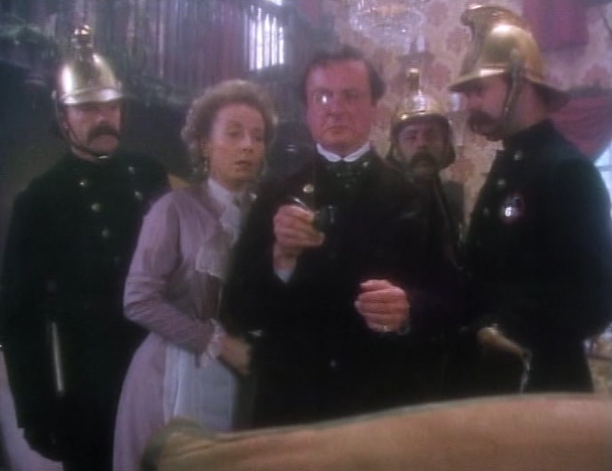
While some of these Christmas memories are general reminiscences about Christmas traditions, others are very specific experiences.  There’s a story of the fire brigade called to a neighbor's home to extinguish a smoky chair lit from an abandoned tobacco pipe.  There's also another story of a group of young boys who go caroling and end up frightening themselves when they sing at the door of a stranger's home and hear a weak and fragile voice on the other side of the front door join them in song. 

Old Geraint also shares about his family's tradition of singing together at Christmas.  Doesn't everyone have an amusing uncle that loves to sing funny songs?

One Christmas long ago, Geraint recalls telephoning the local fire department to help a neighbor extinguish an upholstered chair that had caught fire from a forgotten tobacco pipe.

Though the scenes described above may not sound anything but ordinary--that is exactly the point of Dylan Thomas' story and this TV special.  Even Geraint expresses that his childhood experiences were quite ordinary ones--typical of the times and probably much like other peoples' Christmas traditions.  The joy of this hour-long TV program lies not necessarily in the stories themselves but in the act of remembering and sharing these memories with younger family members.

While sharing his Christmas memories, Geraint gets out the family album to share old photos with Thomas.


Just as Geraint acknowledges, your family's experiences may be ordinary ones but they are special to you and those you share them with.


This TV special (and original prose story) celebrate the Christmas tradition of recalling years past.  The belief that "Christmas is for children" doesn't just mean actual children, but also that Christmas is about returning to one's own childhood experiences to re-live those pleasant, joyful holiday moments from the past.  What I love about A Child's Christmas in Wales is that it is a reminder that some of our most cherished Christmas experiences include the tradition of reminiscing itself.  We should allow ourselves to indulge in recalling wonderful and warm holiday memories, and to share this tradition with the young ones in our lives.  Reminiscing is as much a part of Christmas tradition as decorating the tree and singing carols.

Joanna Wilson is a TV researcher and book author specializing in Christmas entertainment. More about the TV programs mentioned on this website can be found in her book "Tis the Season TV: the Encyclopedia of Christmas-themed Episodes, Specials, and Made-for-TV Movies." Her latest book "Triple Dog Dare: Watching--& Surviving--the 24-Hour Marathon of A Christmas Story" was released in 2016. She is currently updating and expanding the encyclopedia for a 2021 release. Her books can be found at the publisher's website: 1701 press.com

*Support this website and its research by purchasing the books at 1701 press.com

Thursday, December 19, 2013

Bewitched Christmas (1967)

This post first appeared as a part of Dickensfest at Holiday Film Reviews.  Many thanks to JA Morris and RigbyMel for inviting me to participate in Dickensfest--a tribute to Dickens' most popular work A Christmas Carol in honor of the 170th anniversary of the book's release.  You may remember that JA Morris and RigbyMel have guest blogged for me here during my Christmas in July celebrations in 2011, 2012 and 2013


The fourth season episode "Humbug Not to Be Spoken Here" on Bewitched is the second of a total of four Christmas episodes made during the series' run.  This particular episode has some common story elements with the other Bewitched Christmas episodes, and I fear that its legacy has been overlooked.  Maybe I can convince you to take another look at this under-appreciated magical Christmas installment--that includes a much imitated Dickensian spin.

"Christmas is just another day to me," says a Scrooge-like Mr. Mortimer.

In 1967's "Humbug Not to Be Spoken Here," Darrin Stephens finds himself being asked to work late into the night on Christmas Eve--although he's already promised to help his wife Samantha decorate the Christmas tree.

Working late on Christmas Eve, the insensitive Mr. Mortimer obligates his butler Hawkins to continue serving as well.

A new client, the very business-minded Mr. Mortimer is insisting that the details of his advertising campaign can't wait until after the holidays.  When Darrin refuses to work any later, Mortimer follows him to the Stephens' home insisting Darrin continue working or he'll cancel his $500,000 account.

"There's a time for soup and there's also a time for sugar plums!"  Darrin insists that Mortimer's instant soup business can wait.

Later that evening, Darrin tries on his Santa costume he'll use in the morning for his daughter Tabitha.  Meanwhile, Sam speculates on what's wrong with Mortimer.

Sam feels badly for Mortimer and his lack of holiday spirit.  She's sure there's something she can do to reach him and she hatches a plan to inspire Mortimer's belief in Santa Claus.  While Darrin is sleeping in bed, Sam decides to use her magic to take Mortimer on a nighttime journey.

"Think of me as the Spirit of Christmas," says Sam as she awakens Mortimer on Christmas Eve.

There's no Polar Express here--Mortimer is going to take a ride on a witch's broom to the North Pole!
Sam flies into Mortimer's window and awakens him from his bed.  She confesses she's a witch and explains to the angry and confused man that she's taking him on a journey to the North Pole to introduce him to the real Santa Claus. 

With the elves feverishly working in the foreground,  Mr. Mortimer is unimpressed when he meets Santa Claus (background).

At the North Pole, Mortimer is confused and upset and demands to be taken home.  Santa Claus agrees to drop Mortimer off at home when he passes by on his annual trip around the world.  On this long journey with Santa, Mortimer recognizes the home of his butler Hawkins.

Sam and Mortimer see Hawkins dancing around his Christmas tree.

Looking through the front window of Hawkins' home, Sam and Mortimer notice how happy the put-upon butler behaves when he's with his own family.  Mortimer remarks that he's surprised about Hawkins' happiness given that his employee doesn't have much money.

Character actor Charles Lane plays Mr. Mortimer.  Lane made himself a career out of playing curmudgeons.

On Christmas morning, Sam, Darrin, and Tabitha are celebrating Christmas together and opening their gifts when there's a knock on the front door.  It's Mr. Mortimer who explains that he experienced a horrible nightmare last night and has had a change of heart about cancelling his ad campaign.  Sam goes along with his nightmare theory--pretending she doesn't know about his experiences last night.


Darrin in his Santa suit, Sam and Mr. Mortimer--all happy on Christmas morning.

Mr. Mortimer would like to continue working with Darrin after the holidays are over.  He'll have to wait until his butler returns anyway--he sent Hawkins and his family away on an all-expenses paid vacation.  The implication is that Mortimer now appreciates that money can't buy happiness and he regrets punishing Darrin for putting his family first before business.  When Mortimer sees Tabitha under the Christmas tree playing with a one-of-a-kind doll he saw at the North Pole, he's no longer sure what he experienced last night was a nightmare after all.

What sort of Christmas magic occurred last night after all?

What stands out to me in this holiday episode--despite the distracting Santa Claus and North Pole elements--is that this story is structured like an adaptation of Charles Dickens' A Christmas Carol.  Mortimer is focused on the importance of money, he has a lack of holiday spirit, he demands Darrin work on Christmas, and on Christmas Eve while in bed Mortimer is visited by a guide calling herself "The Spirit of Christmas."   For many of us, Santa Claus represents our belief in Christmases past.  Mortimer also visits a Christmas in the present--when he witnesses Hawkins' joy with his family.  And, Mortimer feels transformed by his night time journey, deciding to give gifts to those he's wronged and righting the future for his ad campaign.  The episode's story is a little muddy, but I believe Dickens' original elements are all clearly here.

Is Sam behaving arrogantly by taking it upon herself to teach Mortimer a life lesson?  Probably.  But we love Samantha anyway.

What makes this episode different from typical adaptations of Dickens' A Christmas Carol is that Samantha stands in for the three spirits of Christmases past, present, and future.  Even more precisely, she takes it upon herself to teach Mr. Mortimer a lesson about the holiday spirit by gaslighting him into thinking he's experiencing a supernatural journey during the night of Christmas Eve.  Well, Mortimer is taking a supernatural journey--by way of her witchy magic.  However, instead of a ghostly Jacob Marley character who wants to warn Scrooge about his upcoming painful fate in the afterlife--Sam decides she knows better for Mr. Mortimer and takes it upon herself to teach him a lesson about life.  It's actually kind of arrogant of Sam--but we'll forgive our favorite TV witch, this once!  I think the TV writers found an interesting and clever way to incorporate the much-beloved storyline of A Christmas Carol into this series without turning Sam (or any of the other regular characters) into the vilified Scrooge character.

Bo, Daisy, and Luke Duke each take a turn speaking across the top of the jug to create a spooky voice transmitted on the CB radio, hoping to scare Boss Hogg into transforming his life on Christmas.

I point out this interesting A Christmas Carol story development because I've seen it many times.  As someone who writes about Christmas entertainment, I've seen quite a few television versions of A Christmas Carol where the series' hero takes it upon him/or herself to gaslight an adversary into learning a lesson, usually inspiring the Christmas spirit.  Do you remember any stories like this?  How about the Six Million Dollar Man's 1976 episode "A Bionic Christmas Carol?"  It's also an element within The Dukes of Hazzard's 1980 episode "The Great Santa Claus Chase."  And, it has been done on the 1984 Christmas episode of Highway to Heaven, the 1996 holiday episode of Xena: Warrior Princess, and the 2009 Christmas episode of It's Always Sunny in Philadelphia, among others.  There are more episodes to add to this list--can you name one? 

Col. Steve Austin disguises himself as Santa Claus and shows his adversary visions of his Christmases past, present and future on The Six Million Dollar Man.

I chose to share this particular episode of Bewitched and discuss this unique television spin on Dickens' original tale because I believe this 1967 episode is the first of its kind.  Do you know of an earlier example than this 1967 episode of someone being gaslit into receiving the Dickens treatment?  Let's discuss it.