Known for its themes on the supernatural and the macabre, Rod Serling's Night Gallery doesn't disappoint in the 2nd season holiday episode "The Messiah on Mott Street." The story refers to both Hanukkah and Christmas. Much like the holiday episodes of The Twilight Zone and Alfred Hitchcock Presents, this seasonal offering ends on a happy notetoo.
Rod Serling not only delivers the intro but he wrote this episode as well.
Goldman is stubborn, tenacious and deathly ill.
In "The Messiah on Mott Street," the elderly Abraham Goldman has fallen ill and his condition weakens towards pneumonia with each passing day. The old man is a Jewish immigrant living in a tenement in the ghetto. His physician Dr. Levine warns him that he needs to be hospitalized but the old man refuses to leave his home. Goldman is the sole caretaker of his nine year-old grandson Mikey and he fears the outcome of placing the boy in state-controlled foster care while he seeks treatment in the hospital.
Abraham Goldman is played by the legendary Edward G. Robinson.
Another great addition to the cast: Tony Roberts as Dr. Levine.
The doctor warns Goldman that if he waits a few more days before considering further treatment, he may not live long enough to change his mind. But Abraham is a man of faith. The old man believes that God looks after those in the tenement, a belief that the poor are not forgotten by their Maker. He reassures Mikey that the Messiah will come to take care of him. Mikey believes in the comforting words and beliefs of his grandfather.
Mikey has been raised by his loving grandfather, a wise man of strong beliefs and faith.
Another glimmer of hope to which Abraham clings is a letter he's received from his wealthy brother--a successful farmer in California--who is selling his farm to retire. After the sale of the farm, the brother promises to send money as re-payment to Abraham for a loan from many years ago. Abraham says that when he receives the money, he'll pay his friend Dr. Levine for coming to his home and treating him. He also hopes there will be enough left over to help Mikey and himself live more comfortably (and leave the ghetto).
When Dr. Levine leaves Goldman's apartment, he meets a social worker outside in the hallway. Levine asks about Mikey's future if the old man should die, and about Abraham's next of kin. The social worker reveals that Abraham's brother is a senile old man living in a retirement home in California. There is no money or estate coming that will benefit Abraham or Mikey.
A shadow falls over Abraham--is it The Angel of Death or The Messiah?
However strong in faith, Abraham and his grandson are shaken when a shadow falls over the old man as his condition worsens. Mikey fears it's The Angel of Death but Abraham insists it's The Messiah. The young boy feels like he must do something to help his grandfather and so he heads outside the apartment to look for help. Mikey seeks The Messiah he's heard his grandfather describe as the One who will lift them up and save them from their desperate struggle.
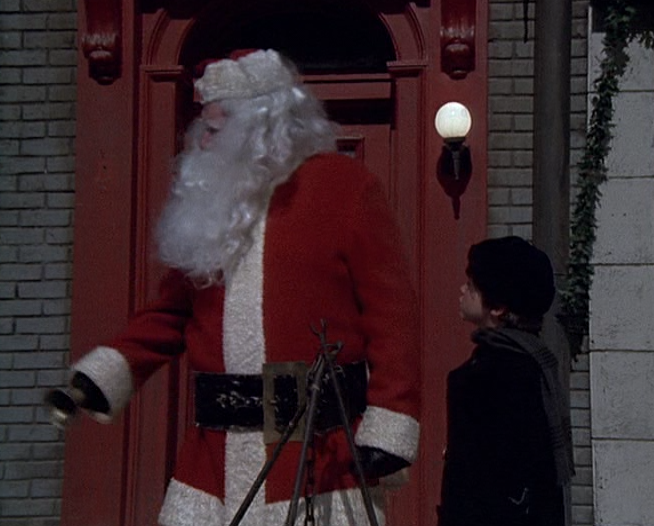
Mikey asks Santa "Are you The Messiah?"
Mikey encounters several people on the cold December streets. It's Christmas Eve so Mickey speaks with a bell-ringing, charity-collecting Santa Claus on the corner. Still looking for The Messiah, Mikey also addresses a doomsday preacher warning sinners about the punishing wrath of God.
The cynicism and fear from the men he meets on the street don't impress Mikey as The Messiah.
Neither of these men reflect the nurturing love and warmth as described by his grandfather for The Messiah. However, one stranger does match the description! And, Mikey grabs him by the hand and leads him to his home.
Hearing about the young boy's sick grandfather, the stranger follows Mikey to his home.
Yaphet Kotto as Buckner.
Back at the apartment, Mikey and the stranger are greeted by the police--and soon Dr. Levine arrives. The old man's condition has worsened. Abraham has fallen unconscious, his condition is too fragile and he can't be moved to the hospital. Everyone fears he may not survive the night. The stranger introduces himself to Dr. Levine as Mr. Buckner. Buckner is a caring person who wishes there was something he could do. Dr. Levine explains that there's little anything anyone can do--the next few hours are critical for the old man. He'll either live or die. Levine discusses the shadowy space between medical science and faith, between cynicism and purity of heart. Mikey is convinced The Messiah will make things better but the two grown men don't know what the future holds.
Has the wind brought in The Angel of Death?
Like we expect from a spooky, supernatural episode of Night Gallery, a strong wind blows the windows and doors open in the apartment. Fearing the worst, Dr. Levine and Mikey rush into the old man's bedroom to check on his condition. Buckner is no longer with them.
Goldman has survived the night!
A miracle has occurred--Abraham sits up in bed and feels well. Goldman describes having a nightmare that The Angel of Death had visited him and promised to return at midnight but it's midnight now (Christmas Eve has become Christmas day) and Abraham feels better. Clearly, the danger has passed. Mikey and Levine express their concern and relief--and they share with the old man their experiences of the past few hours which mysteriously leave out the stranger's appearance in their lives. Next, there's a knock at the door.
Without any recognition, Mikey takes the envelope from the special delivery man at the door.
A letter carrier has a special delivery letter for Abraham Goldman. Mikey signs for the letter and gives it to his grandfather to open. The envelope contains a letter and check from Abraham's brother in California. Just as promised, money has arrived to help them improve their lives. Viewers are left wondering: Are the Angel of Death and The Messiah the same? And, was Buckner The Messiah after all?
Abraham and Mikey have been rewarded for their faith.
While this summary of the Night Gallery episode may read like a typical holiday story, I want to assure you it's anything but. The story is a bit frightening--with talk of The Angel of Death and shadows falling across the sick man's bed. The supernatural elements feel more spooky and unknowable than how holiday miracles are typically portrayed on television. However, the warmth and meaning resonate as satisfyingly as any other holiday TV episode. Whether viewers are celebrating Hanukkah or Christmas, the story's meaning is the same: family, faith, and hope are the reasons for our celebrations.
One way to recognize how popular Christmas entertainment has grown is to see its influence on popular culture. Not only does the 2001 episode "An Eric Forman Christmas" from That 70s Show take its name from A Charlie Brown Christmas, but the episode is filled with references to the Peanuts special, and numerous other Christmas movies and TV specials. Those familiar with That 70s Show will recognize the sarcasm and irreverence that are are found throughout most of the series' episodes however, this 2001 Christmas episode also includes a bit of nostalgia as well.
Eric is only smiling because Kitty insists that Hyde participate in the church's Christmas pageant too.
The story begins with Eric expressing his frustration and disappointment with Christmas. He feels the holiday just isn't the same as it was in the past. Hhmm...sound familiar? His mother Kitty suggests that Eric direct the church's Christmas pageant to help him feel the holiday spirit. Yes--these two elements are also key moments in the 1965 animated TV special A Charlie Brown Christmas.
Eric's friends are no help in inspiring the holiday spirit.
At the pageant rehearsal, Eric is further frustrated by his friends' inability to cooperate with his direction. Jackie unreasonably insists that she play the role of the Virgin Mary--who rides in on a unicorn. Kelso sees his character of Joseph, less as a carpenter and more like a spaceman. Donna doesn't want to play the traditional role of a wise man but a wise woman, and even Fes balks at playing a shepherd. Directing the church's Nativity play doesn't inspire the holiday spirit for Eric.
Kitty catches Red stealing Bob's Christmas decorations.
Meanwhile, Red is disturbed by the bright and loud Christmas decorations set out by his next door neighbor Bob Pinciotti. When Kitty catches Red stealing Bob's decorations, she proclaims "I'm married to the Grinch!"
The teenagers make Kelso feel bad for liking the Christmas specials he watched as a kid.
And, in a third story line, Kelso is excited to watch his favorite animated Christmas TV specials on TV. He specifically mentions the Rankin/Bass specials Rudolph the Red-Nosed Reindeer, Santa Claus is Comin' to Town, and The Little Drummer Boy. When his friends remark that his favorite TV programs are made for children, Kelso feels bad for feeling as excited as he is to watch them.
Kelso pops his head out from a snow bank--much like Hermey does in the 1964 TV special Rudolph the Red-Nosed Reindeer.
Do you have a favorite Animagic Christmas TV special?
Kelso ends up having a dream in which he is a stop-motion animated character inside a Rankin/Bass Christmas special! He shares his frustration with Rudolph, Santa, and the Little Drummer Boy about liking programs made for youngsters--and they tell him to ignore his friends!
References to A Charlie Brown Christmas--and other holiday entertainment--saturate this episode. Above is a shot of the philosophic Leo (yes--that's Tommy Chong) and depressed Eric sharing a heart-to-heart discussion at a wall, much like Linus and Charlie Brown in the classic animated special.
After Pastor Dave discovers Eric smoking in the circle, he is fired from directing the Christmas pageant. In the end, his friends come and apologize for ruining Eric's Christmas. It helps that they give him the one gift he was hoping to find under the Christmas tree this year--a tape deck for the Vista Cruiser. In case you didn't catch it any earlier, Fes even exclaims "Merry Christmas, Charlie Brown!" much like the children do at the end of the animated classic.
To be fair, Fes is always the last one to be in on the joke.
The final image before the credits is the cast of That 70s Show stepping into place to form the traditional First Christmas scene--with Eric's new tape deck in the place of the Savior. I mentioned that this series is irreverent, didn't I?
Check out the complete segment of Kelso's dream--a tribute to Rankin/Bass Animagic Christmas TV specials.
Do you have another favorite TV episode that references Christmas entertainment? Share your comments below.
I'm excited to finally be able to share more information about my new book The Triple Dog Dare: Watching--& Surviving--the 24-Hour Marathon of A Christmas Story. I heard from quite a few of you about the project back in January after I posted this. Thank you for your support, enthusiasm and generosity. The photo above is the front cover artwork. And, the back cover includes the following text:
1 Woman. 1 TV. 1 Movie. 24 Hours.
Every year since 1997, Turner
Broadcasting has aired 24-hours of A Christmas Story from Christmas Eve
through Christmas Day. The marathon has become a cultural
phenomenon—many families tune in and watch the movie at least once—some
watch several times. But no one watches all 24 hours, right?
Christmas TV writer Joanna Wilson trains her expertise on the 24-hour
marathon of A Christmas Story to find out what really happens when you
watch all 12 screenings of director Bob Clark’s classic Christmas movie,
non-stop, commercials and all. Along the way, she discusses the
traditions of Christmas on TV, the nuances of Bob Clark’s filmmaking,
the ongoing appeal of the movie and its relation to the multilayered,
literary storytelling of Jean Shepherd, the activities of binge-watching
and hyper-viewing—and she experiences what may or may not be the first
recorded case of soap poisoning.
I'm also pleased to announce that the book will be released on October 15th, 2016. You'll be able to purchase the book through this website as well as the publisher's site: www.1701Press.com
and other fine book retailers.
Most of us are familiar with the 1944 movie Going My Way starring Bing Crosby. Did you know there was also a TV series with the same characters? Crosby's character Father Chuck O'Malley on the TV series is played by actor Gene Kelly, and Barry Fitzgerald's character Father Fitzgibbon is played by Leo G. Carroll. There's also a new character, Tom Colwell who helps the priests with St. Dominic's parochial school, played by actor Dick York.
In the TV series, Father O'Malley is played by actor/dancer/director Gene Kelly.
Although not set at Christmas time, the 1944 movie Going My Way has always had close associations with the holiday season. Not only is it a family-friendly movie, but the easy-going Father O'Malley is played by Bing Crosby, the iconic singer/actor most closely associated with the seasonal anthem "White Christmas." Many viewers may also enjoy watching Going My Way at the holidays because Father O'Malley starts a boys choir and has them rehearse the carol "Silent Night."
Going My Way's 1945 sequel The Bells of St. Mary's also stars Bing Crosby as Father O'Malley, however this time the film's story centers on the priest's work with Sister Mary Benedict, played by Ingrid Bergman, a nun working to keep an aging parochial school open. The Bells of St. Mary's isn't usually considered a Christmas film either, however it does contain a scene with Crosby singing the Latin carol "Adeste Fideles" with a group of children, and a brief scene with youngsters rehearsing a Nativity pageant. Even if neither movie is set at Christmas time, both Going My Way and The Bells of St. Mary's can be found airing on TV each year in December.
Another reason this pair of movies is so closely associated with Christmas--"The Bells of St. Mary's" appears on the marquee of The Bijou Theater in Bedford Falls when George Bailey runs through town in "It's a Wonderful Life."
If you're a fan of watching Going My Way and The Bells of St. Mary's at the holidays, you may be interested to know that the TV series Going My Way also created a Christmas episode. Finally, we get to see the character of Father O'Malley in a Christmas story! The 1962 episode is entitled "Keep an Eye on Santa Claus."
(left to right) Depew and Shamroy (played by James Dunn) are ex-cons looking for their next big score.
At the start of the episode, we see the aging priest Father Fitzgibbon offering a personal reference to Thompson Department Store on behalf of Honus Shamroy--a man just released from prison who says he's looking for a new start in life. Father O'Malley worries that Fitzgibbon may be risking his good name by helping the ex-con, but Fitzgibbon insists that it's a priest's primary job to help others. Viewers see that Shamroy is already planning a new scheme with another ex-con to rob the department store.
This little girl asks for a rifle for Christmas--sounds familiar, doesn't it?
With the help of Fitzgibbon's recommendation, Shamroy is offered a job working as the store's Santa Claus. A man on the margins of society working as a department store Santa Claus? We've seen this before--remember the 1960 Christmas episode of The Twilight Zone, and the 1955 Christmas episode of Alfred Hitchcock Presents?
Shamroy's loving daughter Karen is played by Cloris Leachman.
One of the reasons Father Fitzgibbon was willing to help Shamroy is because his family has taken him in to live with them. Shamroy's daughter Karen Murdock loves her father and knows he's a good man despite his past mistakes. Karen's young son Mark loves his grandfather too and their relationship is a strong one.
Mark Murdock is played by actor Billy Mumy. I've previously written about Mumy in two other holiday stories including the 1964 Christmas episode of Bewitched and the 1965 Christmas episode of Lost in Space.
Although Shamroy has spent most of Mark's life in jail--telling the young boy that he's in the hospital--the two are good for one another. While Shamroy claims he's working at the department store to earn money for Christmas gifts for Karen and Mark, Mark has decided to join the boys choir at school to make his family happy and proud of him.
Shamroy doesn't want to disappoint his daughter or grandson.
When Shamroy hears his grandson's off-key performance of "Silent Night" in their home, it's the sound of love and joy.
Adorably, Mark has a tin ear and can't sing very well. Karen approaches Father O'Malley to ask him to please include Mark in the boys choir even if he can't hold a tune. This Christmas is very important to her family--for once they are all together. And, soon Mark will be old enough to understand how his much-beloved grandfather is really just a crook. Karen is hoping to enjoy one more holiday with Mark a happy, innocent little boy--before he inevitably becomes betrayed and disappointed by Shamroy. Father O'Malley agrees to make the boy happy and includes him in the boys choir despite his lack of ability.
Father O'Malley is in charge of a boys choir--just as he is in the 1944 movie Going My Way.
Father O'Malley speaks to Shamroy about not disappointing Karen and Mark.
It turns out Honus Shamroy likes his job working as the department store Santa Claus and he's good at it. More importantly, he's come to appreciate how important Karen and Mark's love and respect is to him. He doesn't want to disappoint them any more. At the same time, his buddy Depew has him convinced that their solid plans to rob the store on Christmas Eve are going to make them rich. Shamroy wants to back out of the robbery but he's not sure how.
Can Shamroy stop Depew in time?
As the holiday approaches, Tom Colwell becomes suspicious of Shamroy and Depew. After talking with the police, it becomes clear to everyone that the two lifelong criminals are planning on robbing Thompson Department Store. When the priests confront Shamroy, he wants to back out of the robbery but he feels a duty to his friend Depew to stop him himself--rather than let the police catch him. So O'Mally, Fitzgibbon, and Shamroy head over to the department store hoping to stop Depew before the police arrive.
Even though he has keys to the back door, poor Depew hasn't figured out a way in to the store yet.
Sure enough, they are able to stop Depew before he could break in to the store. (It's explained that his ineptness is precisely why he's spent much of his life behind bars). Although Shamroy can't convince his friend to have a change of heart about the robbery, he does convince him that they police are on their way. The priests are generous with offering their forgiveness to these two souls--neither has technically committed a crime yet. However, the police greet the men in the alley behind the store and are ready to arrest both Shamroy and Depew for conspiracy to commit larceny.
The non-traditional priest inspires the police to offer the ex-cons forgiveness and a second chance at life.
Father O'Malley talks the police officer into letting the men go. He says, "Christmas isn't just for the good and the meek, it's for the saints and it's for the sinners, for great kings and penny ante crooks. It's for all of us, [Officer] Joe, it's for you, and it's for me."
The boys choir once again sings "Silent Night."
The story ends with everyone at the boys choir concert enjoying the holiday music. Shamroy is there listening to his grandson Mark's performance. Depew is seated in the audience too, with the police nearby, keeping a watchful eye on their suspect.
The hour-long episode may move slowly at times--this story was created for television more than 50 years ago, when most TV stories moved at a different pace--but it is as heart-warming as the best of them. I'm also stunned by the episode's outstanding cast.
Leachman and Dunn
If Shamroy looks familiar, that's because actor James Dunn has had a long, successful career. He appeared in several Shirley Temple films in the early 1930s, most notably Bright Eyes--a movie that mostly takes place at Christmas time. Another stunning cast member in this Christmas episode is Cloris Leachman. How long has it been since you've seen the 1976 Christmas episode of her series Phyllis?--the spin-off from The Mary Tyler Moore Show.
Remember this memorable song from the movie Bright Eyes?
Augusta is a sleepy little town located on the banks of the scenic Ohio River.
Last week I went Augusta, KY to visit the Rosemary Clooney House. The singer/actor's personal home has been turned into a museum filled with treasures from Clooney's long career. Getting there was half the fun. Rosemary was raised in nearby Maysville--this is also where she currently rests. But she purchased the beautiful home in Augusta to be near her family and as an isolated getaway between New York and Los Angeles. Since I live in Ohio and was traveling from the north, I took a ferry across the Ohio River to reach Augusta. I recommend it--riding the small ferry was an adventure in itself.
Crossing the Ohio River. On the Ohio side, there are many historic sites and museums dedicated the Underground Railroad and nineteenth century paths taken by escaped Southern slaves seeking freedom in the North.
Sheet music and original 7" recording of Clooney's Christmas hit song "Suzy Snowflake."
Inside the museum, you'll find photos, artifacts, memorabilia, and costumes from Rosemary's singing career and appearances in Hollywood films. Bet I know what you're interested in! The stuff from the 1954 movie White Christmas, right? The museum boasts "the largest collection of White Christmas memorabilia anywhere in the world." Make sure you contact them before you visit--during the holidays, pieces from the collection travel to other museums. (I almost visited late last year but waited until now when I knew the collection was all at the Rosemary Clooney House.)
Remember the sparkly gloves she wears during the song "Love, You Didn't Do Right By Me" in White Christmas?
Pardon the glare from the glass case: here's a blue fan from the performance of "Sisters."
That's Rosemary's brown coat in the back from the scene in which she boards the train. There are lots of Vera-Ellen costumes too.
The "White Christmas" dress in the back is a re-creation, and the "Sisters" dresses have experienced their own long history--ask the museum staff, she'll explain.
Rosemary's bedroom in the house.
The museum also features Rosemary's original bedroom set and her personal items. What a treat it was to see the things she owned and loved. There are more costumes and memorabilia from Clooney's other Hollywood films as well.
The museum also has several Bob Mackie hand-drawn designs of fashions Rosemary Clooney wore.
Geroge Clooney's bib overalls from the Coen Brothers' movie O Brother, Where Art Thou?
Holy smokes! They also have costumes and personal items from her famous nephew--maybe you've heard of him? GEORGE CLOONEY. He was raised in Augusta and the Clooney family still owns several properties there in town, so he occasionally drops by. I looked for him, but he wasn't around when I was there. Go figure. The museum is now run by Heather French Henry (beauty pageant winner Miss America 2000) and her husband Dr. Steve Henry (former Lt. Governor of Kentucky). The museum also features several of their accomplishments too. There's lots to see and experience at the small museum.
Sorry--pardon the glass case glare. Here's a dress worn by Sondra Locke in the movie Rosie: The Rosemary Clooney Story from 1982.
Amanda and I pose in front of a larger-than-life-sized OSU football player in Columbus, OH. Neither of us knows anything about football.
While I was traveling, I also got a chance to visit with Amanda By Night from Made for TV Mayhem website and the Made for TV Mayhem podcast. We spent an evening together in Columbus, OH discussing our favorite TV movies. What more could I ever want?